Thursday, March 17, 2011

Tradition

     Welcome, dear friends, to the season of Lent.  The forty day period of fasting and praying that leads us to the culmination of the Catholic year; Easter.  Lent will also probably be noteworthy in that it will provide me with very little to write about because, as my Grandma always said, prayer and fasting make for boring blogs (I'm not actually sure my grandma knows what a blog is, but if she did, I'm sure she would adhere to that school of thought).  However, the beginning of the Lenten season did give me fodder for at least one more blog in the form of Carnaval (fat tuesday) and the other celebration of the Señor de Esquipulas which falls on March 9th every year; which this year, just so happened to be Ash Wednesday.
     Over my life I have experienced various traditional ways celebrations of Fat Tuesday.  From grade school, where they would serve us an extra dessert at lunch, to high school, where we probably got to go without uniforms for a day, to college, where overindulging on alcohol and greasy foods was the norm, and finally to Guatemala, where they smash eggs filled with confetti over each others' heads and dress up like Disney characters.  At least that seems to be the going tradition at the grade school I visited on the morning of Ash Tuesday.  It's always fun to see kids here in Guatemala, they make me feel at home because kids are the same everywhere, even when smashing eggs on your head.  The tradition at the library was a bit different, and seemed to be "work like it is a normal day," while the tradition at the high school was to paint sawdust.  Maybe that one deserves a little explanation.  Every year for the 9th of March, the people of Esquipulas take to the streets to make "alfombras" which literally translates to rug or carpet.  These alfombras are made in the streets from sawdust and other organic materials.  The tradition goes back to the times of the conquistadores, and is loosely based on the Palm Sunday teaching of laying palm branches on the ground.  While most of the alfombras are made around Easter, Esquipulas has carried the tradition over to March 9th as well.  However, no one wants a sawdust colored carpet, so the first step in the process must be painting the sawdust. 


     To this end, the entire school had no classes in the afternoon and all of the students spent their time dyeing the sawdust.  It was quite the impressive operation.  As you can see in the picture above, the entire soccer field was full of students getting down and dirty with the dye.  They even talked me into helping, though I was very picky on the colors I wanted to use.

 
 (Go Vikings!)

     With all of the sawdust dyed and properly stored for the night, the activities of fat Tuesday came to an end and I said goodbye to the all the things I gave up for Lent.  The next day, although technically a day of fasting, was more of a day of feasting in Esquipulas, where the people were not really willing to give up the feast of their Black Christ just for Ash Wednesday.  I spent the morning helping the students of San Benito's High School make their alfombras or, more accurately, I took pictures and learned how alfombras are made while they worked.  
     As you can see in the picture below, the first step in making an alfombra is a base.  Plain, colorless sawdust is used to fill in the cracks in the road and smooth out the bumps, and then other colors are generally laid down to form a colorful background. 
 

     The next stage is making the designs on the alfombras.  These are generally made using a template that they have cut out of cardboard, but a decent amount were also made free hand.  At this stage they talked me in to helping, and I took the moment for an awesome photo op.  


     I also got drafted for some other duties.  Below:  "ahh... Miss Karin, what is this alfombra supposed to say?"
     "Where's there love, there's peace"
"... hmm... I think we may want to fix that"
 
And just like that, a Black Eyed Peas allfombra was averted.  

 
 This was one of my favorite alfombra.  The entire thing was done free hand!


As you can tell, there were quite a few alfombras.  The ones pictured here are only those made by the Colegio San Benito!


     I had originally intended on including all sorts of pictures about the other alfombras throughout town, but apparently I have limited picture storing space on this blogger account and I don't want to use up all my space for the next 2.5 months on one blog about sawdust, so this will have to do.  I'll upload the rest to Facebook if you are interested in seeing them. 
     However, just because the pictures have ended doesn't mean the story has!  I took the afternoon off from work as well to wander around the town and check out the rest of the alfombras.  Don't feel to bad for my coworkers for having to work without me though, because all the high schools had the day off, and hardly anybody came to the library.  The alfombras from the town were pretty varied.  Some were incredibly detailed works of art, and others were... not so detailed.  But even so, it was really cool to see a town come together and work on something as unique and beautiful as decorating the streets they walk and drive on.  
     In the evening, also as per tradition, was the "quema del castillo."  This was basically an incredibly dangerous fireworks display in honor of the Cristo Negro.  I say dangerous because the entire time ash from the fireworks was falling on the crowd and multiple times embers, large burning pieces of fireworks, and even rockets were launched into the crowd which was so big that a stampede was a serious worry of the event organizers.  However, nothing bad happened, and hardly anybody was hurt.  In addition, I got to witness yet another great part of Esquipulan culture and tradition.
     Thus ended the Second celebration of the Señor de Esquipulas, in a blaze of fire.  And, unfortunately, it rained the next day, turning all of the dyed sawdust in the streets into horrible mess all over Esquipulas.

Sunday, March 13, 2011

Pura Vida

     This last week I celebrated my 6 month Guatemalan birthday, and I celebrated the calendar turning over to March, and to the last third of my Central American adventure, in Costa Rica with one of my best friends and study abroad partner, Dave Harrison.  Similar to my last vacation (Belize), this break came at a very opportune time as I was very ready to get out of the monastery for a little while, and found a beach vacation to be the perfect escape.  This trip was unique, however, in that instead of using the time away to experience how other volunteers are living, I was able to share it with someone who was fresh from the USA, and was able to get the news on the motherland as well as get an interesting new perspective on Central America from someone who hasn't just spent the last 6 months here.
     My trip started with a night in Antigua Guatemala, which was a nice warm up for Costa Rica because both Costa Rica and Antigua are crawling with gringos.  It is one of the only places in Guatemala where not only can I blend in, but I'm probably in the majority.  I stayed at a hostel where I met some awesome people (seriously, if you ever travel, stay at hostels) and then set out to meet another friend of mine from Chile, Amanda, who was to be my guide to the nightlife of Antigua.  You heard me right, nightlife!  I probably wouldn't have believed it either if I hadn't seen it myself.  It turns out that Antigua is unique not only for the amount of tourists but also because it is one of 5 places in Guatemala with a nightlife:  Antigua, Zone 9 and 10 of Guatemala City, Xela, and Flores.  Antigua is really different from Esquipulas, and I really enjoyed the experience of a Guatemalan Disco. 
     The next day I woke up to a game of soccer, and then hit the road for the second leg of the trip.  The plane ride from Guatemala City to San Jose was absolutely gorgeous.  The route took us south right along the coast and because it was a short flight we never got high enough that I couldn't see the landscape.  To top it off, our pilot must have been a tour guide in a past life, because over the flight he would come on the intercom just to tell us of some volcano or river or other important feature that we could see just outside our windows.  Although it was a great flight, there's only so much time that one can spend comfortably on a plane, and my limit is about 15 minutes, so I was more than happy to land. 
     I landed at 5:30, and I thought that Dave was coming in around 6:30, which would leave me with only an hour wait outside of an airport, not bad.  Then the 6:30 plane from Miami came in, and I waited.  And all the people on that flight came out, and I waited.  And I figured that maybe he had problems with his checked luggage, so I waited some more.  And then I thought that maybe I got the flight number wrong and he was on the 7:10 flight from Dallas.  So I waited.  And the people came out from that one, and I waited for Dave.  And he didn't come.  I ended up waiting until 8:45, and which point I figured he had missed his plane, so I caught a cab from the friend of a taxi driver I had been talking to all night, and he promised that if he found Dave he would send him on to the hostel.  He gave me his card and I told him, "remember, he is a really tall guy who answers to David."  10 minutes down the road my taxi driver got a phone call from the guy I left at the airport, who had found Dave.  It turns out he was on a flight that came in at 8:30, and I left literally minutes before he came out of the airport.  Oops.
     I met Dave at the hostel, which was an interesting place, and we discussed at length whether or not we wanted to taste some of the San Jose nightlife.  Our hostel seemed like a fun place to party and everyone was headed to a bar later, but after so much travel in one day, Dave and I were only able to handle two beers before falling asleep.  The next day we decided to check out the day life in San Jose, a place which every tourist and tourist website says to avoid like the plague.  Not because it is bad, but because it is not a volcano, beach, or nature reserve, therefore making it just a rest stop on the way to other cool places in Costa Rica.  Because of that, we had little hope for the city.  However, it turns out San Jose is a really cool place.  It was Sunday, so the people of San Jose had taken to the streets to play, watch makeshift parades, and exercise.

 In this picture alone there is a soccer game (left), a volleyball game (center), and a small child canopying over the street (top left).  

     The entire main street was filled with people dancing, playing, skateboarding, and just hanging out.  The only thing missing was cars. Our entire time in San Jose we found the lack of smog and traffic jams incredible.  It turns out that the City of San Jose has driving bans: Only cars whose license plates end in certain numbers can drive on any given day.  It seemed to me like kind of a heavy handed way of dealing with the problem, but in a city of millions, most we saw were taking public transportation, so I guess it worked.


     San Jose is also home to some pretty cool sculptures and architecture, which we saw during our solo walking tour, but we found that one day in the city was enough, and after one day, headed for the beach.
     To get there, however, we had to take a bus.

 
     They don't make buses in Costa Rica to fit a 6'8" David (to be fair, I don't think they do in the USA either), and to make matters worse, the bus broke down twice.  While this was very frustrating, I'd like to point out that in Guate, if a bus breaks down only twice and each break down costs less than 15 minutes, that's a great bus ride. 
     After about 5 hours on bus, we found ourselves in the town of Quepos on the south west coast of Costa Rica, near the national park of Manuel Antonio.  Once again, after traveling in buses all day, we were far to tired to go out on the town (also, it was Monday), so we hit the sack pretty early.  After a less than comfortable night's sleep (read, horribly hot and humid without air conditioning) we decided to pack up and head for the rain forest.  We got a very nice room right with air conditioning next to Manuel Antonio for decently cheap due to the fact that huge resorts had all moved in up the hill and destroyed these hotels' business, and headed for the park.  Although the guides were decently expensive ($20 a person) we decided to get one because, after all, this was one of the reasons I wanted to go to Costa Rica.  The guide turned out to be a great decision.  He had all sorts of information on the different species of the rain forest,  and was incredibly good at finding sloths hiding in the trees.  For example, can you spot the sloth hiding in the trees in this picture?


He did. 

    We were able to find some sloths on the trails though...


Another example of the guide's vision.  This crab was seen through a telescope and zoomed in on the camera.


I really liked the sloths.


     We then made it to one of the two beaches in this national park and found it crawling with monkeys.  The monkeys were bold enough to come right up and steal people's lunches as they went for a swim!  I didn't think places like this existed, but here it was.  It was truly an awesome place.

      
     After the park, we went to the beach to relax, but, being a couple of landlocked Minnesota boys, we found the prospect of playing in the surf much more entertaining than sleeping on the beach.  The sun set and we hiked up a mountain side to find a restaurant where we had some of the best seafood we've ever had.  After dinner we headed back down the mountain side only to find that all the good bars and places to hang out were back at the top of the mountain.  After much discussion, we decided that we were too tired from all of the activity of the day to hike back up, so once again we called it an early night.
     We got up decently early (early to bed, early to rise) and made our way towards Jacó, a surfer town just north up the coast from us.  Based on some advice we got the first day, we headed to a hostel called "papas and burgers."  It was lucky that we found it too, because the first hotel we checked out turned out to be where all of the prostitutes take their clients, so I doubt that we'd have had a very peaceful night's sleep.  Now, on our first day in the country we were also told that Wednesday night at a bar called "the backyard" was the best night of parties in the entire area, but this recommendation came with a warning.  Apparently, because it was ladies night, the bar would be full with "mad bitches."  We wondered all week why there would be dogs in the bar, and even more pressing, why they would be so angry.  Every time we discussed this troubling warning we became more and more intrigued, and our desire to actually make it to a bar one night of the trip grew.  To this end, we limited beach time and activities, so as to conserve energy (also, it rained most of the day).  
     Finally the night came and we made our way to the backyard.  Much to our relief there was not one dog in the entire establishment.  What's more, the majority of the people there seemed to be in good spirits, not one looked mad!  That being said, after the rave review, we found The Backyard to be nothing really special.  I commented to Dave that it is just like Sal's bar except in Costa Rica and with far more prostitutes.  Some people from South Africa heard us say that and commented that it is just like a bar in their home town too, but with far less prostitutes.  A gentleman from England said the same, as did an Aussie.  It turns out that bars and parties are the same just about everywhere, and it has more to do with the people you're with than the inherent "fun" of a bar, "mad bitches" or not.  We did have a fun night though, and we are now able to say that we experienced the nightlife of Costa Rica, if only for one night.
    The next day, our last full day in Costa Rica, we were able to experience another almost unavoidable Costa Rican happening: horrible horrible sunburn.  I guess that's what happens when you forget your sunscreen and spend multiple hours on the beach.  The only thing I have going for me is that the parts not covered by my shirt already had a good base, so the blistering and peeling was limited to the concealed parts of my body, reducing the embarrassment a little.  I can only imagine what Dave's virgin Minnesota skin is going through...
     Having experienced all that we had hoped for in Costa Rica, we caught a bus back to San Jose for the last night.  The next morning, we got up bright and early to fly back to our respective countries, and I bid farewell to Dave and Costa Rica.  It was really a vacation to remember.

The plane ride to Guatemala went as expected, and my bus ride was far better than I had hoped for: It only broke down twice!

Thursday, February 24, 2011

Patience

     Patience is a virtue, the old saying goes.  And, while I have never possessed that virtue in great abundance, I have never needed more patience than here in Guatemala.
     In the 22 years I have spent in the 1st world I have grown accustomed to a certain standard, this standard often simply cannot be met in land of eternal spring.  I often find myself wanting commonplace USA things that are anything but commonplace here in Guatemala.  For instance, while digging a hole in the orange orchard I was craving a shovel whose handle doesn't snap in half when used to dig dirt, and when trying to build an above ground garden I wanted a hammer whose handle doesn't snap when used to remove a nail.  These tools, however, were nowhere to be found.  Sometimes I get a strong desire for constant quality electricity or internet or telephone service, and that desire often goes unquenched.  Once in a while I find myself feeling particularly selfish and want buses that leave on time, students who show up regularly to class, friends who arrive within 15 minutes of when we say we'll meet, and most of all, water that isn't full of bacteria that are trying to kill me slowly from the inside out. 
     However, I realize that, most of the time, that is just my United States upbringing clashing with my Guatemalan life.  The problem comes from the fact that in the United States there is a truly incredible and unmatchable level of efficiency.  I never realized it before, but back home everything seems to work.  Things work so well that it is shocking, alarming, and newsworthy if they do not work.  Roads are smooth, and if they are not, they are repaired, and if they are not someone writes a story about it in the newspaper.  Hospitals have medicine, and if they do not, they get it, and if they do not, someone writes a story about it in the newspaper.  When something slows the efficiency of our daily commute (whether it be an accident, snow, or some other event) they talk about it on the news because, even though it is fun to complain about the daily commute, it is shockingly rare that something so bad happens that people can't make it to work.  In the United States, a senator is suing a restaurant for $150,000 over an olive pit he found in a sandwich.  I have literally not eaten one tamal here in Guatemala that was not full of chicken bones.  The soup is even worse.   I remember when the Hog's Breath restaurant was under legal trouble for an E. Coli outbreak.  In Guatemala, I'm on a first name basis with E. Coli, Salmonella, and a handful of other bugs that live in every drop of tap water in this country.  While it sounds whiny and privileged, the fact of the matter is that as a United States citizen I am used to things working right, on time, and without problems.  That is just not the way things work here, and I have to exercise my patience on a regular basis because of it. 
     One particular facet of my volunteer experience here has had my patience doing laps every time I think about it.  It happens to the the Ciudad de Felicidad orphanage.  While I once had very high hopes for this place, I have experienced one disappointment after another there, and am honestly quite frustrated.  The first project to fail was the hospital.  The price tag on this project, coupled with the lagging economy, drove it straight into the ground.  After that disappointment I was looking for something a little easier.  When a friend suggested that I build a "huerto" (basically an above ground vegetable garden) and said he would supply vegetable seeds, I felt up to the task.  I asked the nuns if they would be able to care for the plants and utilize the vegetables, and they all gave an emphatic "SI."  The first phase of building went well.  Despite the heat of November, I got the wood cut to size and some holes dug.   I actually kind of enjoyed it, as this was something I had practiced a lot over the past few summers in the Boundary Waters.


     After the completion of this first phase, I was nearly done, all that was left was to connect the wood and drop it in the holes.  This is where the bad luck/lack of quality tools/the fact that Guatemala is quite a bit different than the United States caught up with me.  My first thought was that I could just get a battery powered screw gun, march on up to the orphanage, pound out the project and start growing vegetables.  Turns out screw guns haven't found their way to Esquipulas.  No problem, I could just get a drill, make holes, and screw the pieces together.  Then I found out that the climate of months of heavy soaking rains followed by long dry periods is bad for wood that is left out.   My boards were far to warped to screw together.  I actually cracked one board trying to screw it to another.  In fact, if you look careful enough at the picture above, you might notice that the right end of the board is laying flat while the right side is at about a 20 degree angle to the ground.  Also, the electricity at the orphanage was not reliable or robust enough to power the electric drill.
     With all of the civilized options used up, I decided to go caveman on the board and just pound it to submission with a hammer and nails. 
 Guess not.
     Right about this time I fell ill with stomach amoebas and couldn't work.  Once those were cleared up my 90 day stay in Guatemala ended and I had to go on a week long vacation.  When I finally returned to the orphanage I discovered that all of the nuns thought I had left for good and all of the wood had been reappointed to different projects.  Oh, I also found out that they had decided to uncover the 10' by 20' huerto they already had but forgot to tell me about and plant all the seeds I gave them in that.  By the end of this disaster project I made a pictorial diagram for Willian (from the library) explaining why the project has failed. 

     I took a break from the Ciudad de Felicidad after those failures, but the whole while I was thinking about my next project, solar power for the orphanage.  I did my research, figured out what would be needed to start, and even had about $3000 raised for me (thank you Sister Stephanie).  However, most of the things required for solar panels, even the correct batteries, are produced in the United States, and are very VERY expensive to ship to Guatemala.  While I am still looking for ways to work it out, this project has been moved to the back burners. 

After the death of the huerto I went for a walk to cool my head, and found something rather surprising.  It turns out that mine weren't the only projects to fail in the Barrio de Santa Ana. 


     This is an entire sub-development that had been planned in the area.  Streets, light poles, ditches for a sewage system.
 I would NOT want to be stuck here at night.
 And the tubing for the sewage system
     
     There were even old faded advertisements to potential builders in the area.  I first thought that maybe this was built recently and they had just delayed development, but then I found this.

 
     That is a tree growing out of a concrete.... something.  That's right, a tree. That is at least 2 years worth of growth.  So, in light of this, I do not feel so bad about failing with my projects at the orphanage.  While a garden may not be as hard to build as a city, it's not nearly as big a loss as I saw here in the ghost town. 

     I don't want to give the City of Joy a bad rap.  It is really a wonderful place and I have had some good times there as well.  Also, it is not my only source of frustration here in Guatemala.  Not by a long shot.  Allow me to elaborate with a story...
      I had made plans two weeks ago to visit a friend of mine who is volunteering near Lake Atitlán.  While that is slightly more than the distance from Oakdale to Hibbing (a 3 hour drive), I was told to expect a nine hour bus ride due to the mountains, bad roads, and constant stopping of buses.  I prepared myself for the ride, even picking out a few books from the library, and was ready to go.  however, the day I was supposed to leave, I became sick with stomach problems, no doubt due to one of the good friends I have listed above.  I put off the trip for another week and this time even watched what I ate the whole week to avoid potential problems.  Friday came again, and this time everything seemed to work out or me and the wind was at my back.  I caught a ride with the monastery's driver all the way to the capital, and found the parish driver from San Lucas Toliman in the capital and convinced him to give me a ride out that way.  I didn't have to take one bus!  I had a great time at Lake Atitlán which definitely is one of the most beautiful places on earth, and got a chance to visit Erin, a good friend since my days in Chile.

It was also really pretty there
 AND they have an alternative to microbuses!  They are just pickups that you stand up in the back of though...


     However, when I woke up Monday to come home I found that the breeze at my back all the way to the lake had not changed directions, and had become gale force (that means it was against me).  While I had set my alarm clock for a very comfortable 7:30, I found myself awake at 6:00 feeling like something wasn't right.  It turns out that the things that weren't right were my intestines, so I made my way to the bathroom (multiple times) to rid myself of the problem.  As always when you need to travel and have problems with... continence... the best bet is the pharmacist.  I made my way there and took some pills, but by the time they had taken effect, the morning round of buses had already left San Lucas.  So I waited.  And Waited.  And finally a chicken bus came which brought me to the capital without problems, I thought.  However, it dropped me off just outside the city at the center of transportation.  The Rutas Orientales station is in the center of the city.  That turned out to be a problem.  I took the bus into the city and it dropped me off at a plaza.  Even though streets are not at all well marked in Guatemala City I figured I could find my way home from a plaza.  After all, how many plazas can there be?  2 hours of wandering around later I found my way to the Rutas Orientales station.  It turns out there are a lot of plazas in the city, and the particular one I was in wasn't on my map.  The delays in San Lucas and the capital cost me the dream of being home in time for a nap before vespers I was still confident about making it back in time for vespers and dinner.  Then the bus broke down.  Then the bus broke down again.  Then the bus broke down a third time.  By the time I got home, the typical 5 hour ride had taken 7 and I hadn't eaten all day due to the stomach issues  was dealing with.  To make matters worse, every restaurant in town that was still open at 8:30 was packed because it was Valentine's day.  So I cut my losses and went to sleep.

      I have commented earlier on the very common phrase "primero Dios" or "God willing."  While I didn't quite understand it at the time, every day and every incident like the few I've mentioned above, I find myself coming closer and closer to understanding why that phrase is so common.   This Friday my second set of 90 days in Guatemala expire.  Saturday morning I will be headed to Costa Rica to spend a week on the beach with a good friend, Dave.  God willing.


Wednesday, February 2, 2011

The Winds of Change

     The Festival of "Nuestro Señor de Esquipulas" was a very active and fun time here at the monastery but it also signaled some big changes for the town of Esquipulas, and especially me and my work.  these changes were so profound and sweeping that everything after this week will henceforth (in this blog at least, but I'm trying to get it to catch on) be known as the Common Guatemalan Era. 
     The last few months I have been here, I have picked up work at the library, the City of Joy, the Library, and a few odd projects on the side for anyone who needs an English translator or someone to run to the Capital.  I picked up all of these jobs because I felt I was expected to do something, but mostly just to keep the boredom at bay and make myself feel useful.  I feel I should mention that when I say that I was expected to do something I use that term lightly:  As I've said before, that "something" that I was expected to do was go to prayers twice a day and maybe work.  If I felt like it.  However, the Monday after the festival was the first day of high school and grade school classes after the "summer" break, that means that I suddenly have a lot of work, work which has moved my other projects to the backburner.  My morning work has moved from working in the fields with Leonidas to full time Library duty with the increased number of students.  The change in the library is truly incredible.    Apparently the library I work at is the only complete one in Esquipulas due to the "government's refusal to put money into the East Side of the country," which means that students from all 5 of the high schools in town and both of the primary schools all come to our library, as well as anyone who needs documents photocopied.  That means the library has been almost continuously packed full for the last 2 weeks, forcing me to take on a more or less full time morning job there.  I even have a uniform!  It is nice to know that I am helping provide such a necessary service to the people of Esquipulas.  It is amazing to me that in a country with the second worst literacy rate in the Western Hemisphere libraries are so undervalued that there the nearest public one is an hour away (then again, that's where the nearest hospital is too...).  I also really enjoy the work there, even though it is exhausting, it is a wonderful way to practice my spanish and meet new people.  I've noticed that since the dawn of the CBE and the student rush at the library, every time I leave the basilica 3 or 4 people wave to me or call out my name or start conversations with me.  It's kind of fun being the only gringo in town!
     While the library keeps me busy in the morning, I am assisting with English classes at Colegio San Benito in the afternoons.  That has been a lot of fun and, while I don't get to practice Spanish as much, I'm still meeting a lot of new people and at least once a day I learn something about the English language that I didn't know.  Oh, and I have a uniform for the Colegio San Benito too.  I guess I'm kind of a big deal. 
    If I time it right I can usually swing by the library after classes right after they've finished cleaning, so I have gotten into the habit of spending what little free time I have everyday hanging out with my friends from the library.
     I finish off most days with my two English classes.  Sadly these were not immune to the change that was sweeping through my life here.  The first Wednesday of the CBE saw 15 new students drop into my comfortable class of 7-8, nearly tripling the size.

 Standing room only

     While I'm glad that more people have a desire to learn English and are taking advantage of my classes, I didn't plan on this, and it has really slowed down the class, much to the chagrin of my old students.  If I could do it all over again I would set up two or three classes with a start and end date throughout the year, allowing students to join without slowing the class down, but hindsight is 20/20 and we are moving on.  Plus, this next session is the Gerund, which is really easy so it is a nice time to catch up. 

     Now, I can hear you saying "Adam, all of that sounds like a lot of work, are you keeping up with your rest?"  Well, thank you for asking. As a matter of fact BOOOM I've been a little BAANG behind on sleep due to the POWWW fact that my usual half TING TING TIN hour nap after lunch has been CRASSSSHHHH taken over by another change moving through the monastery.  With the new CBE, the monks have decided that it is time to fix all of the cracks in the stucco walls.  That means workers pounding with hammers and chisels all day long right outside of my room.

I mean right outside my room.  That is my window right next to the man with the chisel.

The construction has more or less rendered my room unlivable from 8:00 am until 4:30 pm everyday.  It has been a little bit of a bummer, and has left me somewhat like a zombie wandering around the monastery in those first wee hours of the afternoon.  I have rescheduled my class schedule to allow for soccer every Monday, Wednesday, Friday, and Saturday, which has been a big help.  It's amazing how exercise, as opposed to making me more tired, gives me so much energy. 
     There is one last change here that I'd like to tell you about.  The Basilica has recently hired a new chef.  He comes from the Belizean Navy, where he picked up some truly incredible skills (almost superpowers as far as I can tell):  Cooking without black beans!  He only uses his strange powers occasionally so as to not frighten the monks with his bold and dangerous style, but his contributions to the monastery have reduced our bean consumption from 2-3 times every day (leaning more towards the 3) to 2-3 times a day (leaning more towards the 2).  That being said, tortillas are still a staple that is not to be challenged, surviving even when this revolutionary new chef decides to serve pizza.  I have really enjoyed the slightly changed diet, and my digestive tract has appreciated a lower quantity of beans however, this changing diet has turned out to be a bit of a double edged sword.  While he has let beans go to the wayside on various occasions, he has a certain affinity for liver.  Like, a twice a week affinity.  I hate liver.  Almost as much as I hate the Packers.
     By the way, I'll probably cry if they win the Superbowl.

Tuesday, January 25, 2011

Nuestro Señor de Esquipulas

     This last week, Esquipulas was overrun by thousands of religious pilgrims who had made the trip to Esquipulas to see the Black Christ.  During the week long festivities I saw pilgrims from every country in Central America and Mexico, some from Jamaica and Ecuador and, of course, at least one Estadounidense.  I have a huge amount of respect for the faith that these people have that compels them to travels hundreds or even thousands of miles in often very uncomfortable buses and over questionable roads to worship God.  However, despite my great respect, I have never truly understood the idea behind a religious pilgrimage.  It seems to me that an omnipotent god would be present everywhere in the world, not just one special corner of Guatemala.  And, even if we accept the paradigm that God prefers to operate more profoundly in certain places, wouldn’t she probably chose one of the more awesome places that she spent all that time creating on earth… like at least place with awesome beaches?  That being said, I definitely understand the concept of traveling many miles for a good party, and that is essentially what Esquipulas experienced this week.  As can be expected, thousands of pilgrims bring with them lots and lots of money.  Lots and lots of money attracts people who want to alleviate these travelers of the need to carry that extra weight back home with them.  Hence, a giant street festival complete with food, a carnival, outdoor bars, and vendors selling every product you could ever imagine wanting to buy was born.   When I say anything you could imagine, I mean it; during this festival, one could find almost anything they wanted to blow their money on.  Pots and pans, socks, lighting fixtures for houses, lingerie, tequila shots, gambling, and even supporting the arts (through the medium of the mass amounts of street performers).  It originally struck me as odd that bars were popping up all over the street corners with gambling booths spread liberally throughout the city during a religious holiday but then I realized that these vendors were serving a very useful purpose.  Imagine making the trek all the way to Esquipulas only to realize that you are fresh out of sins to confess.  That would be a tragedy!  Fear not, however, for in one city block you can get brain meltingly drunk, blow your last month’s pay on gambling AND try out your skills at the add-hock shooting range!
    Needless to say, there are a decent amount of people from Esquipulas who do not like the festival very much.  And often with good reason: Esquipulas is full to the brim with pilgrims and salesmen, the sheer quantity of people stealing electricity causes mass blackouts to dominate the town for the majority of the week; a very non-negligible number of people were killed by the crazy driving habits of stressed (and possibly drunk?) people from all corners of Central America; and there are nowhere near enough bathroom or trash facilities in this town to facilitate the hundreds of thousands of pilgrims, meaning that waste (both the normal kind and the human kind) was deposited unceremoniously throughout the city.  Despite these setbacks, the festival brought with it a very fun environment, with everyone there in high spirits and enjoying the week.  And I've heard estimates that this week alone brings in around 40% of the money made in Esquipulas in a year... strangely I didn't hear anyone complain about that.
     At this point I am completely incapable of further explaining the sheer number of people, so I'll leave you with some stats, then lots of pictures.  For the around 10,000 pilgrims who saw the Cristo Negro each day, there was around a 7 hour wait in line.  Given that there is only one Cristo Negro, 10000 pilgrims and 86,400 seconds each day, that means each person averaged 7 hours in line for 8.64 seconds of Cristo Negro time.  Truly unbelievable. 
     I would also like to offer my sincerest apologies for last week's blog to all of my friends who struggle reading all the way through the name of their cereal every morning, and those of you who have asked for less words and more pictures (here's looking at you Eddie).  As my act of contrition for the egregious number of words unaccompanied by pictures in the last blog, please accept these 30 pictures of Esquipulas under the siege of the pilgrims.


These following pictures are of the streets of Esquipulas during the "feria."  On the right is during, on the left is the Monday after the holiday.  
Above, on the left, is the bar selling tequila shots.  


Below are pictures of the carnival that came to town.  There have been three carnivals in town (for about 3 weeks each) since I came to Esquipulas.  All three have played "we no speak americano" without stop for their entire stay here.  I never want to hear that song again. 


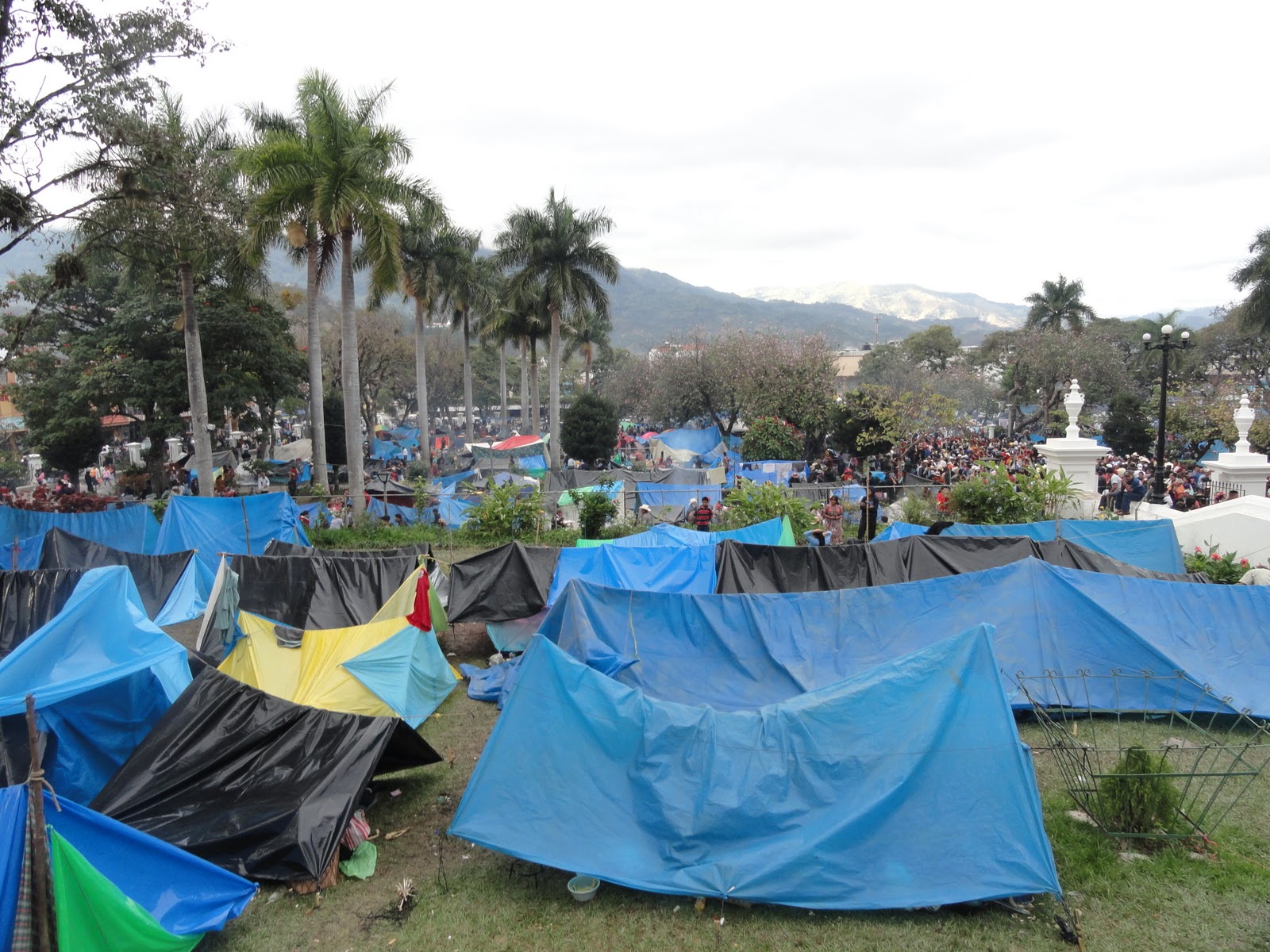
The front lawn of the Basilica was transformed into a makeshift campground. 


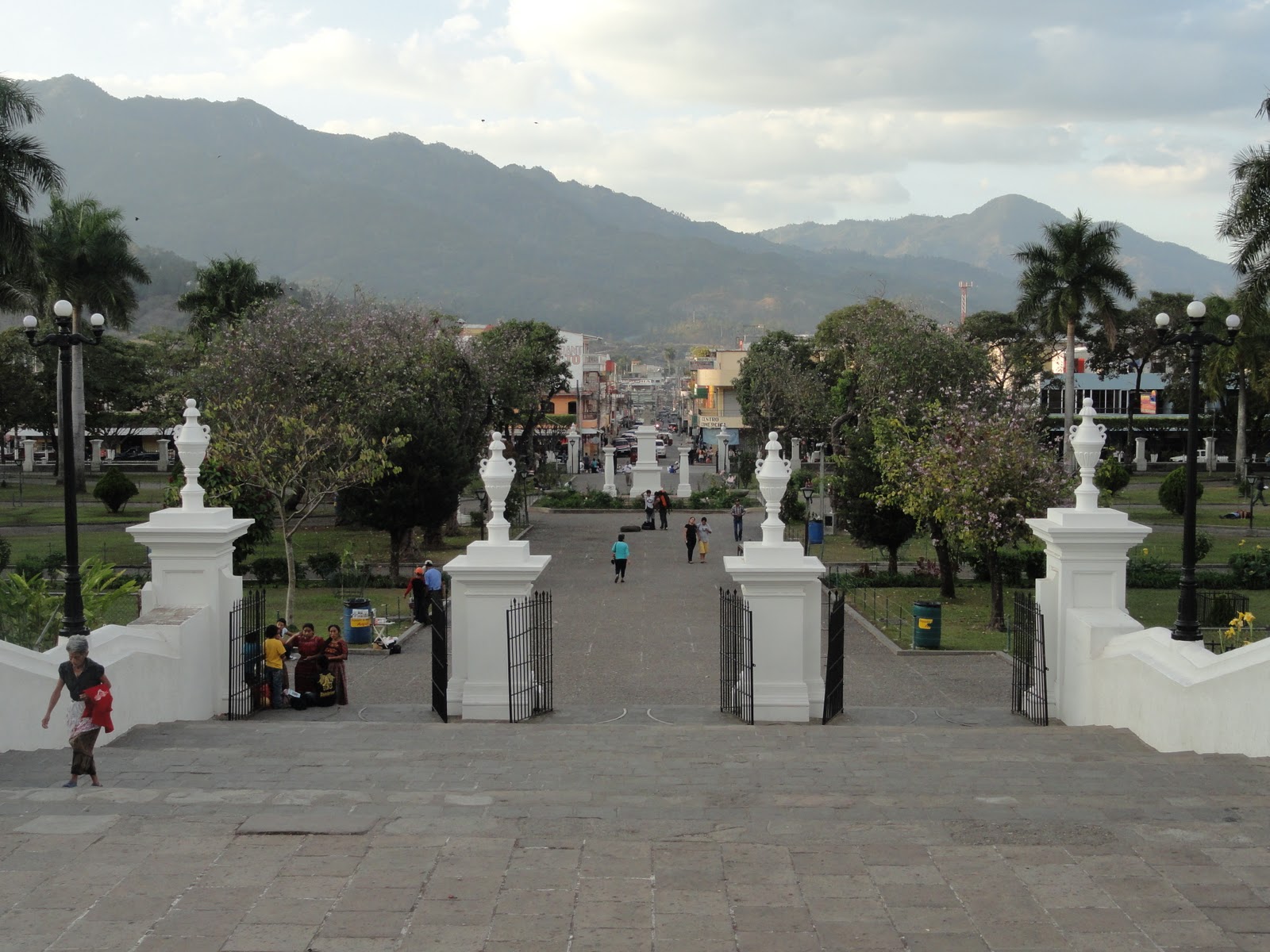
The night leading up the the 15th, they have a concert in the main plaza of the Basilica.  They call it the serenade of the Cristo.  It was completely packed, and a lot of fun.


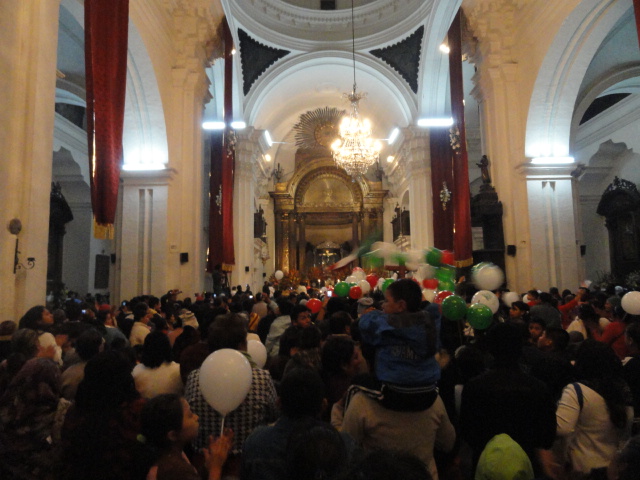
To use an old, tired platitude; there was "standing room only" for the mass at midnight on the 15th.  Oh, and I don't mean in the basilica, I mean in the area directly surrounding it, in the courtyard, in the park, and in the streets surrounding the park. 


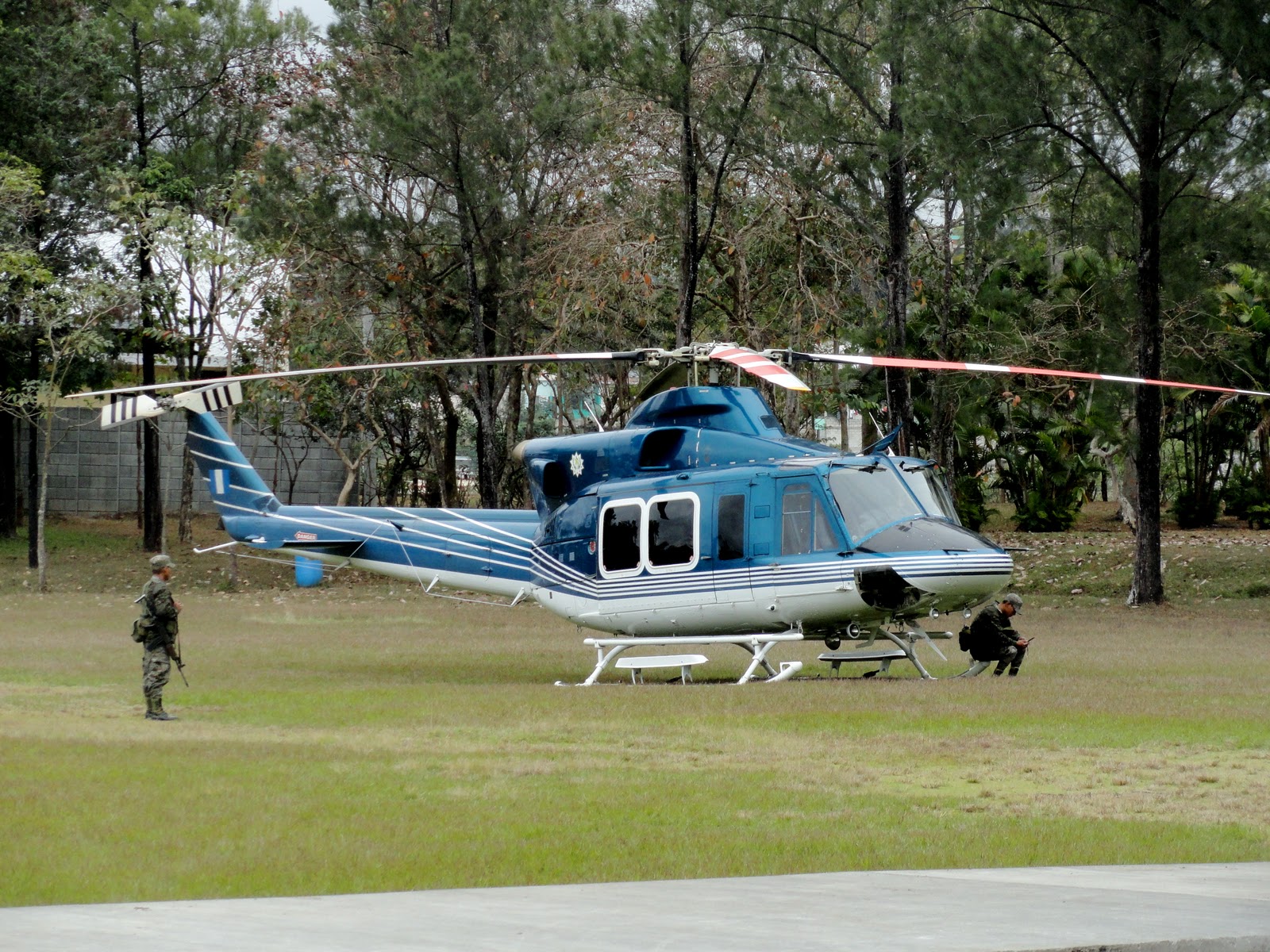
And then, after being up all night for the mass, I decided I would skip Laudes and sleep in.  I was woken up about 7:00 by a helicopter that seemed like it was flying awfully close to the Basilica.  
Turns out the Vice president of Guatemala wanted to stop by to see the Cristo.  
To all of my Chile friends:  I think meeting the VP tops meeting Ariel Dorfman. 

Sadly, hundreds of thousands of pilgrims have quite a negative impact on a little town like Esquipulas.  However, no later than Sunday afternoon, they townspeople took to the streets en masse each with a broom in hand to clean up the mess.  By Monday, the only places where I could take an appropriately dirty picture were in the places where they couldn't reach!


Oh, and some people showed up from Mexico to do some dances. 

I think they represent the Conquistadores?

After all of their sword fights, they all advanced on this poor woman.
I didn't really understand it.


P.S.  For anyone interested, apparently they do this twice more (although on a smaller scale) while I am here in Esquipulas.  March 8th (yep, mardi gras) for the celebration of bringing the Cristo from Antigua to Esquipulas, and Holy Week.  You are more than welcome to come down and experience the madness for yourself.