Thursday, February 24, 2011

Patience

     Patience is a virtue, the old saying goes.  And, while I have never possessed that virtue in great abundance, I have never needed more patience than here in Guatemala.
     In the 22 years I have spent in the 1st world I have grown accustomed to a certain standard, this standard often simply cannot be met in land of eternal spring.  I often find myself wanting commonplace USA things that are anything but commonplace here in Guatemala.  For instance, while digging a hole in the orange orchard I was craving a shovel whose handle doesn't snap in half when used to dig dirt, and when trying to build an above ground garden I wanted a hammer whose handle doesn't snap when used to remove a nail.  These tools, however, were nowhere to be found.  Sometimes I get a strong desire for constant quality electricity or internet or telephone service, and that desire often goes unquenched.  Once in a while I find myself feeling particularly selfish and want buses that leave on time, students who show up regularly to class, friends who arrive within 15 minutes of when we say we'll meet, and most of all, water that isn't full of bacteria that are trying to kill me slowly from the inside out. 
     However, I realize that, most of the time, that is just my United States upbringing clashing with my Guatemalan life.  The problem comes from the fact that in the United States there is a truly incredible and unmatchable level of efficiency.  I never realized it before, but back home everything seems to work.  Things work so well that it is shocking, alarming, and newsworthy if they do not work.  Roads are smooth, and if they are not, they are repaired, and if they are not someone writes a story about it in the newspaper.  Hospitals have medicine, and if they do not, they get it, and if they do not, someone writes a story about it in the newspaper.  When something slows the efficiency of our daily commute (whether it be an accident, snow, or some other event) they talk about it on the news because, even though it is fun to complain about the daily commute, it is shockingly rare that something so bad happens that people can't make it to work.  In the United States, a senator is suing a restaurant for $150,000 over an olive pit he found in a sandwich.  I have literally not eaten one tamal here in Guatemala that was not full of chicken bones.  The soup is even worse.   I remember when the Hog's Breath restaurant was under legal trouble for an E. Coli outbreak.  In Guatemala, I'm on a first name basis with E. Coli, Salmonella, and a handful of other bugs that live in every drop of tap water in this country.  While it sounds whiny and privileged, the fact of the matter is that as a United States citizen I am used to things working right, on time, and without problems.  That is just not the way things work here, and I have to exercise my patience on a regular basis because of it. 
     One particular facet of my volunteer experience here has had my patience doing laps every time I think about it.  It happens to the the Ciudad de Felicidad orphanage.  While I once had very high hopes for this place, I have experienced one disappointment after another there, and am honestly quite frustrated.  The first project to fail was the hospital.  The price tag on this project, coupled with the lagging economy, drove it straight into the ground.  After that disappointment I was looking for something a little easier.  When a friend suggested that I build a "huerto" (basically an above ground vegetable garden) and said he would supply vegetable seeds, I felt up to the task.  I asked the nuns if they would be able to care for the plants and utilize the vegetables, and they all gave an emphatic "SI."  The first phase of building went well.  Despite the heat of November, I got the wood cut to size and some holes dug.   I actually kind of enjoyed it, as this was something I had practiced a lot over the past few summers in the Boundary Waters.
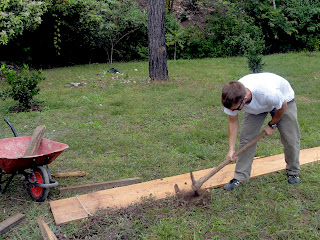

     After the completion of this first phase, I was nearly done, all that was left was to connect the wood and drop it in the holes.  This is where the bad luck/lack of quality tools/the fact that Guatemala is quite a bit different than the United States caught up with me.  My first thought was that I could just get a battery powered screw gun, march on up to the orphanage, pound out the project and start growing vegetables.  Turns out screw guns haven't found their way to Esquipulas.  No problem, I could just get a drill, make holes, and screw the pieces together.  Then I found out that the climate of months of heavy soaking rains followed by long dry periods is bad for wood that is left out.   My boards were far to warped to screw together.  I actually cracked one board trying to screw it to another.  In fact, if you look careful enough at the picture above, you might notice that the right end of the board is laying flat while the right side is at about a 20 degree angle to the ground.  Also, the electricity at the orphanage was not reliable or robust enough to power the electric drill.
     With all of the civilized options used up, I decided to go caveman on the board and just pound it to submission with a hammer and nails. 
 Guess not.
     Right about this time I fell ill with stomach amoebas and couldn't work.  Once those were cleared up my 90 day stay in Guatemala ended and I had to go on a week long vacation.  When I finally returned to the orphanage I discovered that all of the nuns thought I had left for good and all of the wood had been reappointed to different projects.  Oh, I also found out that they had decided to uncover the 10' by 20' huerto they already had but forgot to tell me about and plant all the seeds I gave them in that.  By the end of this disaster project I made a pictorial diagram for Willian (from the library) explaining why the project has failed. 

     I took a break from the Ciudad de Felicidad after those failures, but the whole while I was thinking about my next project, solar power for the orphanage.  I did my research, figured out what would be needed to start, and even had about $3000 raised for me (thank you Sister Stephanie).  However, most of the things required for solar panels, even the correct batteries, are produced in the United States, and are very VERY expensive to ship to Guatemala.  While I am still looking for ways to work it out, this project has been moved to the back burners. 

After the death of the huerto I went for a walk to cool my head, and found something rather surprising.  It turns out that mine weren't the only projects to fail in the Barrio de Santa Ana. 


     This is an entire sub-development that had been planned in the area.  Streets, light poles, ditches for a sewage system.
 I would NOT want to be stuck here at night.
 And the tubing for the sewage system
     
     There were even old faded advertisements to potential builders in the area.  I first thought that maybe this was built recently and they had just delayed development, but then I found this.

 
     That is a tree growing out of a concrete.... something.  That's right, a tree. That is at least 2 years worth of growth.  So, in light of this, I do not feel so bad about failing with my projects at the orphanage.  While a garden may not be as hard to build as a city, it's not nearly as big a loss as I saw here in the ghost town. 

     I don't want to give the City of Joy a bad rap.  It is really a wonderful place and I have had some good times there as well.  Also, it is not my only source of frustration here in Guatemala.  Not by a long shot.  Allow me to elaborate with a story...
      I had made plans two weeks ago to visit a friend of mine who is volunteering near Lake Atitlán.  While that is slightly more than the distance from Oakdale to Hibbing (a 3 hour drive), I was told to expect a nine hour bus ride due to the mountains, bad roads, and constant stopping of buses.  I prepared myself for the ride, even picking out a few books from the library, and was ready to go.  however, the day I was supposed to leave, I became sick with stomach problems, no doubt due to one of the good friends I have listed above.  I put off the trip for another week and this time even watched what I ate the whole week to avoid potential problems.  Friday came again, and this time everything seemed to work out or me and the wind was at my back.  I caught a ride with the monastery's driver all the way to the capital, and found the parish driver from San Lucas Toliman in the capital and convinced him to give me a ride out that way.  I didn't have to take one bus!  I had a great time at Lake Atitlán which definitely is one of the most beautiful places on earth, and got a chance to visit Erin, a good friend since my days in Chile.

It was also really pretty there
 AND they have an alternative to microbuses!  They are just pickups that you stand up in the back of though...


     However, when I woke up Monday to come home I found that the breeze at my back all the way to the lake had not changed directions, and had become gale force (that means it was against me).  While I had set my alarm clock for a very comfortable 7:30, I found myself awake at 6:00 feeling like something wasn't right.  It turns out that the things that weren't right were my intestines, so I made my way to the bathroom (multiple times) to rid myself of the problem.  As always when you need to travel and have problems with... continence... the best bet is the pharmacist.  I made my way there and took some pills, but by the time they had taken effect, the morning round of buses had already left San Lucas.  So I waited.  And Waited.  And finally a chicken bus came which brought me to the capital without problems, I thought.  However, it dropped me off just outside the city at the center of transportation.  The Rutas Orientales station is in the center of the city.  That turned out to be a problem.  I took the bus into the city and it dropped me off at a plaza.  Even though streets are not at all well marked in Guatemala City I figured I could find my way home from a plaza.  After all, how many plazas can there be?  2 hours of wandering around later I found my way to the Rutas Orientales station.  It turns out there are a lot of plazas in the city, and the particular one I was in wasn't on my map.  The delays in San Lucas and the capital cost me the dream of being home in time for a nap before vespers I was still confident about making it back in time for vespers and dinner.  Then the bus broke down.  Then the bus broke down again.  Then the bus broke down a third time.  By the time I got home, the typical 5 hour ride had taken 7 and I hadn't eaten all day due to the stomach issues  was dealing with.  To make matters worse, every restaurant in town that was still open at 8:30 was packed because it was Valentine's day.  So I cut my losses and went to sleep.

      I have commented earlier on the very common phrase "primero Dios" or "God willing."  While I didn't quite understand it at the time, every day and every incident like the few I've mentioned above, I find myself coming closer and closer to understanding why that phrase is so common.   This Friday my second set of 90 days in Guatemala expire.  Saturday morning I will be headed to Costa Rica to spend a week on the beach with a good friend, Dave.  God willing.


Wednesday, February 2, 2011

The Winds of Change

     The Festival of "Nuestro Señor de Esquipulas" was a very active and fun time here at the monastery but it also signaled some big changes for the town of Esquipulas, and especially me and my work.  these changes were so profound and sweeping that everything after this week will henceforth (in this blog at least, but I'm trying to get it to catch on) be known as the Common Guatemalan Era. 
     The last few months I have been here, I have picked up work at the library, the City of Joy, the Library, and a few odd projects on the side for anyone who needs an English translator or someone to run to the Capital.  I picked up all of these jobs because I felt I was expected to do something, but mostly just to keep the boredom at bay and make myself feel useful.  I feel I should mention that when I say that I was expected to do something I use that term lightly:  As I've said before, that "something" that I was expected to do was go to prayers twice a day and maybe work.  If I felt like it.  However, the Monday after the festival was the first day of high school and grade school classes after the "summer" break, that means that I suddenly have a lot of work, work which has moved my other projects to the backburner.  My morning work has moved from working in the fields with Leonidas to full time Library duty with the increased number of students.  The change in the library is truly incredible.    Apparently the library I work at is the only complete one in Esquipulas due to the "government's refusal to put money into the East Side of the country," which means that students from all 5 of the high schools in town and both of the primary schools all come to our library, as well as anyone who needs documents photocopied.  That means the library has been almost continuously packed full for the last 2 weeks, forcing me to take on a more or less full time morning job there.  I even have a uniform!  It is nice to know that I am helping provide such a necessary service to the people of Esquipulas.  It is amazing to me that in a country with the second worst literacy rate in the Western Hemisphere libraries are so undervalued that there the nearest public one is an hour away (then again, that's where the nearest hospital is too...).  I also really enjoy the work there, even though it is exhausting, it is a wonderful way to practice my spanish and meet new people.  I've noticed that since the dawn of the CBE and the student rush at the library, every time I leave the basilica 3 or 4 people wave to me or call out my name or start conversations with me.  It's kind of fun being the only gringo in town!
     While the library keeps me busy in the morning, I am assisting with English classes at Colegio San Benito in the afternoons.  That has been a lot of fun and, while I don't get to practice Spanish as much, I'm still meeting a lot of new people and at least once a day I learn something about the English language that I didn't know.  Oh, and I have a uniform for the Colegio San Benito too.  I guess I'm kind of a big deal. 
    If I time it right I can usually swing by the library after classes right after they've finished cleaning, so I have gotten into the habit of spending what little free time I have everyday hanging out with my friends from the library.
     I finish off most days with my two English classes.  Sadly these were not immune to the change that was sweeping through my life here.  The first Wednesday of the CBE saw 15 new students drop into my comfortable class of 7-8, nearly tripling the size.

 Standing room only

     While I'm glad that more people have a desire to learn English and are taking advantage of my classes, I didn't plan on this, and it has really slowed down the class, much to the chagrin of my old students.  If I could do it all over again I would set up two or three classes with a start and end date throughout the year, allowing students to join without slowing the class down, but hindsight is 20/20 and we are moving on.  Plus, this next session is the Gerund, which is really easy so it is a nice time to catch up. 

     Now, I can hear you saying "Adam, all of that sounds like a lot of work, are you keeping up with your rest?"  Well, thank you for asking. As a matter of fact BOOOM I've been a little BAANG behind on sleep due to the POWWW fact that my usual half TING TING TIN hour nap after lunch has been CRASSSSHHHH taken over by another change moving through the monastery.  With the new CBE, the monks have decided that it is time to fix all of the cracks in the stucco walls.  That means workers pounding with hammers and chisels all day long right outside of my room.

I mean right outside my room.  That is my window right next to the man with the chisel.

The construction has more or less rendered my room unlivable from 8:00 am until 4:30 pm everyday.  It has been a little bit of a bummer, and has left me somewhat like a zombie wandering around the monastery in those first wee hours of the afternoon.  I have rescheduled my class schedule to allow for soccer every Monday, Wednesday, Friday, and Saturday, which has been a big help.  It's amazing how exercise, as opposed to making me more tired, gives me so much energy. 
     There is one last change here that I'd like to tell you about.  The Basilica has recently hired a new chef.  He comes from the Belizean Navy, where he picked up some truly incredible skills (almost superpowers as far as I can tell):  Cooking without black beans!  He only uses his strange powers occasionally so as to not frighten the monks with his bold and dangerous style, but his contributions to the monastery have reduced our bean consumption from 2-3 times every day (leaning more towards the 3) to 2-3 times a day (leaning more towards the 2).  That being said, tortillas are still a staple that is not to be challenged, surviving even when this revolutionary new chef decides to serve pizza.  I have really enjoyed the slightly changed diet, and my digestive tract has appreciated a lower quantity of beans however, this changing diet has turned out to be a bit of a double edged sword.  While he has let beans go to the wayside on various occasions, he has a certain affinity for liver.  Like, a twice a week affinity.  I hate liver.  Almost as much as I hate the Packers.
     By the way, I'll probably cry if they win the Superbowl.

Tuesday, January 25, 2011

Nuestro Señor de Esquipulas

     This last week, Esquipulas was overrun by thousands of religious pilgrims who had made the trip to Esquipulas to see the Black Christ.  During the week long festivities I saw pilgrims from every country in Central America and Mexico, some from Jamaica and Ecuador and, of course, at least one Estadounidense.  I have a huge amount of respect for the faith that these people have that compels them to travels hundreds or even thousands of miles in often very uncomfortable buses and over questionable roads to worship God.  However, despite my great respect, I have never truly understood the idea behind a religious pilgrimage.  It seems to me that an omnipotent god would be present everywhere in the world, not just one special corner of Guatemala.  And, even if we accept the paradigm that God prefers to operate more profoundly in certain places, wouldn’t she probably chose one of the more awesome places that she spent all that time creating on earth… like at least place with awesome beaches?  That being said, I definitely understand the concept of traveling many miles for a good party, and that is essentially what Esquipulas experienced this week.  As can be expected, thousands of pilgrims bring with them lots and lots of money.  Lots and lots of money attracts people who want to alleviate these travelers of the need to carry that extra weight back home with them.  Hence, a giant street festival complete with food, a carnival, outdoor bars, and vendors selling every product you could ever imagine wanting to buy was born.   When I say anything you could imagine, I mean it; during this festival, one could find almost anything they wanted to blow their money on.  Pots and pans, socks, lighting fixtures for houses, lingerie, tequila shots, gambling, and even supporting the arts (through the medium of the mass amounts of street performers).  It originally struck me as odd that bars were popping up all over the street corners with gambling booths spread liberally throughout the city during a religious holiday but then I realized that these vendors were serving a very useful purpose.  Imagine making the trek all the way to Esquipulas only to realize that you are fresh out of sins to confess.  That would be a tragedy!  Fear not, however, for in one city block you can get brain meltingly drunk, blow your last month’s pay on gambling AND try out your skills at the add-hock shooting range!
    Needless to say, there are a decent amount of people from Esquipulas who do not like the festival very much.  And often with good reason: Esquipulas is full to the brim with pilgrims and salesmen, the sheer quantity of people stealing electricity causes mass blackouts to dominate the town for the majority of the week; a very non-negligible number of people were killed by the crazy driving habits of stressed (and possibly drunk?) people from all corners of Central America; and there are nowhere near enough bathroom or trash facilities in this town to facilitate the hundreds of thousands of pilgrims, meaning that waste (both the normal kind and the human kind) was deposited unceremoniously throughout the city.  Despite these setbacks, the festival brought with it a very fun environment, with everyone there in high spirits and enjoying the week.  And I've heard estimates that this week alone brings in around 40% of the money made in Esquipulas in a year... strangely I didn't hear anyone complain about that.
     At this point I am completely incapable of further explaining the sheer number of people, so I'll leave you with some stats, then lots of pictures.  For the around 10,000 pilgrims who saw the Cristo Negro each day, there was around a 7 hour wait in line.  Given that there is only one Cristo Negro, 10000 pilgrims and 86,400 seconds each day, that means each person averaged 7 hours in line for 8.64 seconds of Cristo Negro time.  Truly unbelievable. 
     I would also like to offer my sincerest apologies for last week's blog to all of my friends who struggle reading all the way through the name of their cereal every morning, and those of you who have asked for less words and more pictures (here's looking at you Eddie).  As my act of contrition for the egregious number of words unaccompanied by pictures in the last blog, please accept these 30 pictures of Esquipulas under the siege of the pilgrims.


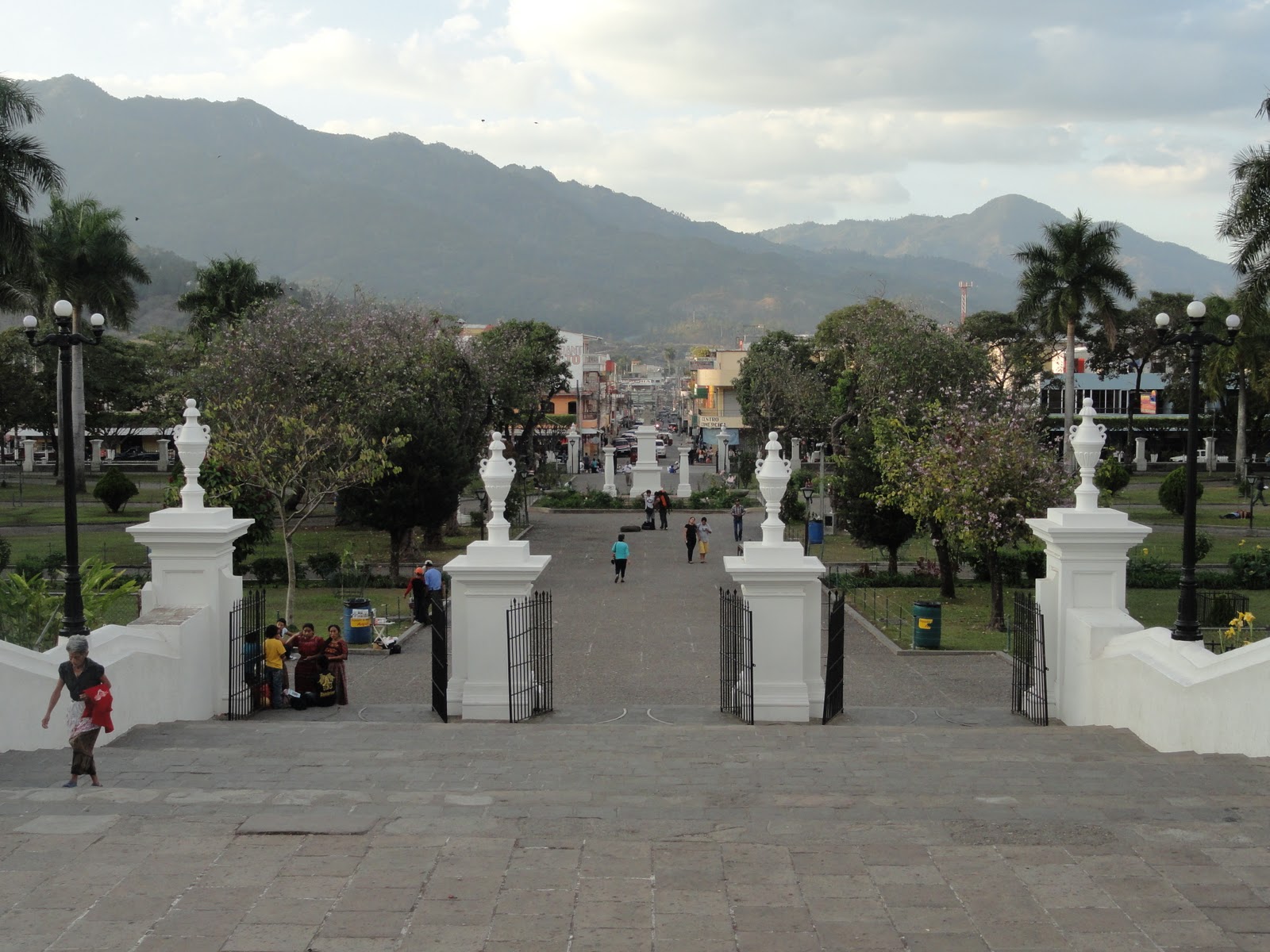
These following pictures are of the streets of Esquipulas during the "feria."  On the right is during, on the left is the Monday after the holiday.  
Above, on the left, is the bar selling tequila shots.  


Below are pictures of the carnival that came to town.  There have been three carnivals in town (for about 3 weeks each) since I came to Esquipulas.  All three have played "we no speak americano" without stop for their entire stay here.  I never want to hear that song again. 


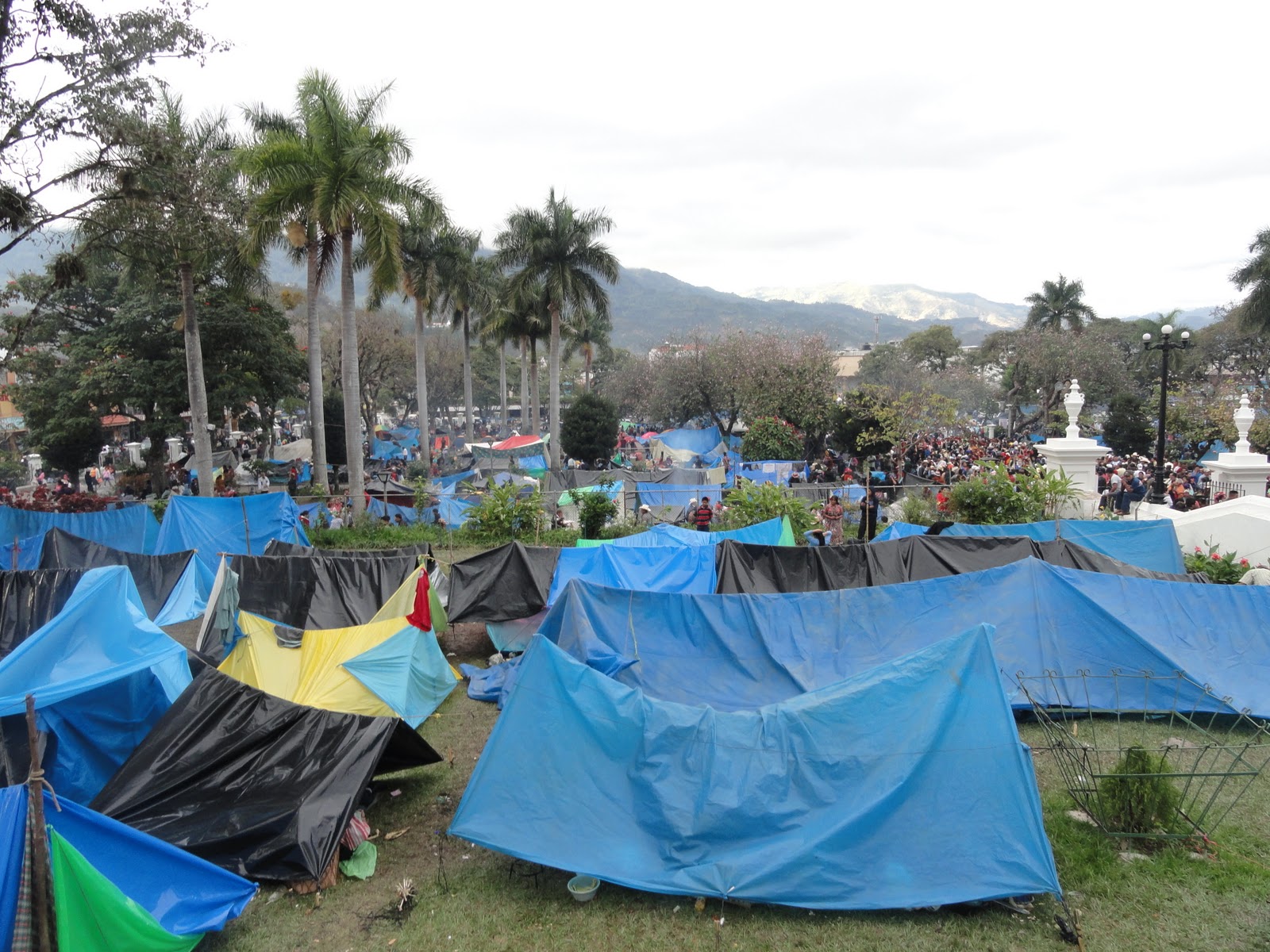
The front lawn of the Basilica was transformed into a makeshift campground. 


The night leading up the the 15th, they have a concert in the main plaza of the Basilica.  They call it the serenade of the Cristo.  It was completely packed, and a lot of fun.


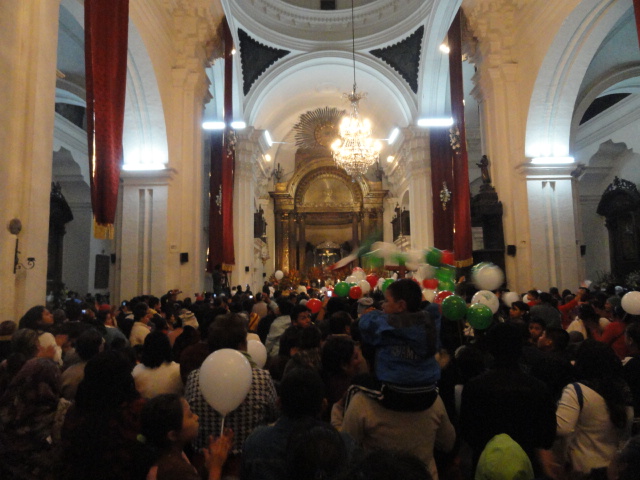
To use an old, tired platitude; there was "standing room only" for the mass at midnight on the 15th.  Oh, and I don't mean in the basilica, I mean in the area directly surrounding it, in the courtyard, in the park, and in the streets surrounding the park. 


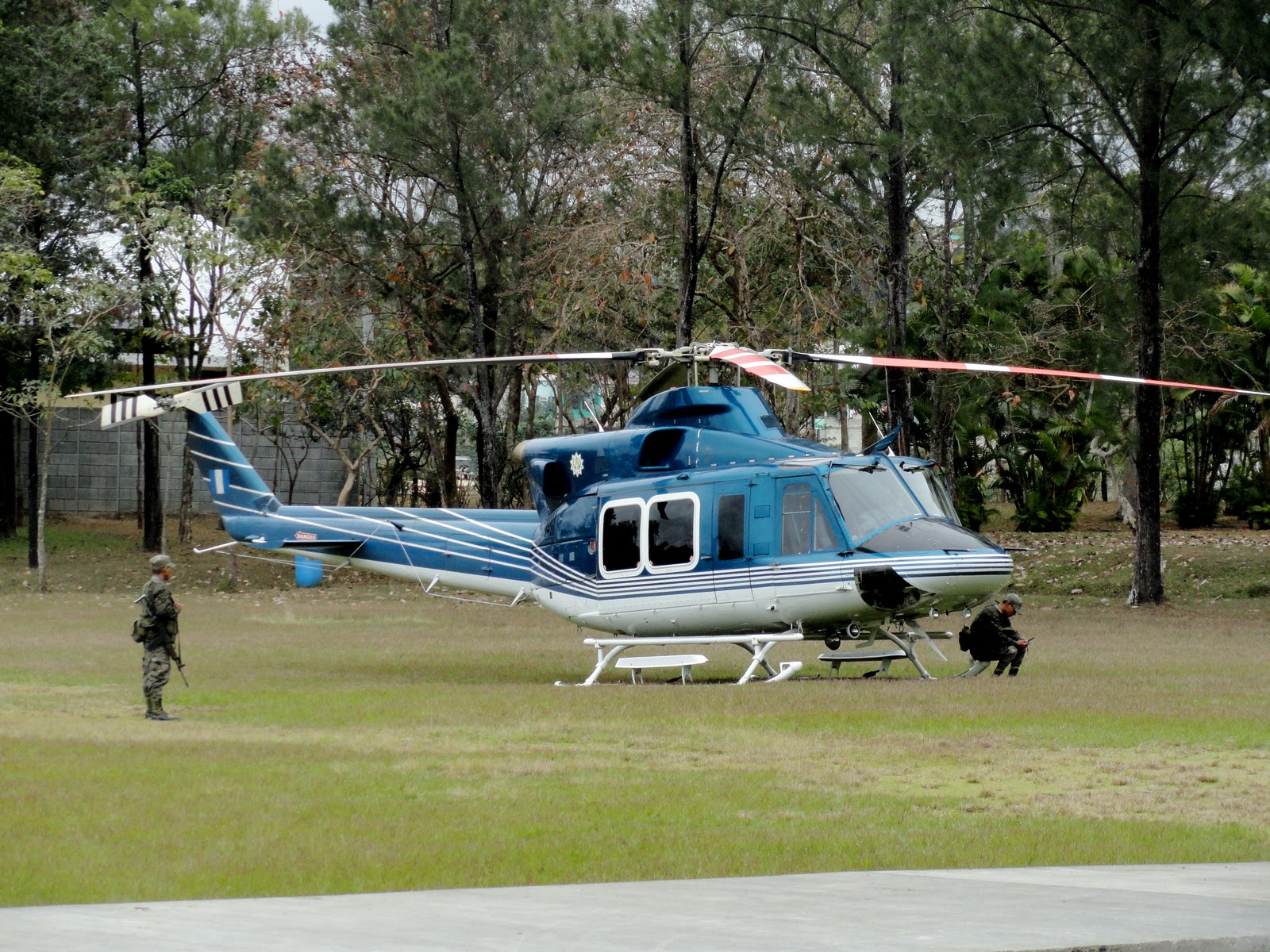
And then, after being up all night for the mass, I decided I would skip Laudes and sleep in.  I was woken up about 7:00 by a helicopter that seemed like it was flying awfully close to the Basilica.  
Turns out the Vice president of Guatemala wanted to stop by to see the Cristo.  
To all of my Chile friends:  I think meeting the VP tops meeting Ariel Dorfman. 

Sadly, hundreds of thousands of pilgrims have quite a negative impact on a little town like Esquipulas.  However, no later than Sunday afternoon, they townspeople took to the streets en masse each with a broom in hand to clean up the mess.  By Monday, the only places where I could take an appropriately dirty picture were in the places where they couldn't reach!


Oh, and some people showed up from Mexico to do some dances. 

I think they represent the Conquistadores?

After all of their sword fights, they all advanced on this poor woman.
I didn't really understand it.


P.S.  For anyone interested, apparently they do this twice more (although on a smaller scale) while I am here in Esquipulas.  March 8th (yep, mardi gras) for the celebration of bringing the Cristo from Antigua to Esquipulas, and Holy Week.  You are more than welcome to come down and experience the madness for yourself.

Sunday, January 16, 2011

2010-Greatest hits

        The beginning of a new year always feels like the perfect time to do some reflecting on the year past and the one to come.  2010 was a pretty huge year for me, with graduation and me entering the "real world" for a whole 3 months (long enough for me to realize I wanted nothing to do with it) and my subsequent (and not unrelated) trip to Guatemala.  While the first part of the year was very important for me, it is undoubtedly not of interest to you, my fine reader, who traversed thousands of bytes of internet information to arrive at this page in search of stories about my latest experiences and jinxes in Guatemala.  After all, how would stories about my life in Minnesota fit in a blog titles "Adam Between Oceans"?...
     Anyways, I've been in Guatemala four months now.  A fact that surprises me every day.  It amazes me both that the time has gone so fast and that I have fit so much into the short 4 months I have been here.  I've now begun my second English class, which meets Tuesday and Thursday, completing the 5 day English class cycle.  I'm working on some projects at the Ciudad de Felicidad and, although the Hospital idea crashed, and the garden took a nose dive, it's been good to be able to do some good work there, and at least playing with the kids is always fun.  Starting next week, the third week in 2011, I will be helping in San Benito's high school with English classes (and maybe math and physics?) and, as always, I'm having fun in the library and the orange orchard.  It actually amazes me that, though I haven't accomplished a whole lot, I've been incredibly successful at making myself busy in a monastery where my only real obligation is to pray twice a day. 
     That being said, I would like to use this blog to write some of the memories I have accumulated over the past 4 months into the internet history books.  I'll try to make this more interesting than just a lame old journal entry, but if I fail, please accept my apologies.  

Slang
Slang is an interesting thing.  Every culture has it, it changes drastically from place to place, and it gives some great great local flavor to the dialect of a place.  As far as I can tell, slang first came about when everybody in a certain family, town, city, region, country, or continent decide that some nonsense word will henceforth mean something else or, even worse, that a perfectly fine word should take on a new, often more sinister, meaning; and there you have it, new slang is born (holy long sentence batman!).  I remember in grade school, one student decided that erasers should be slang for breasts.  It made no sense, but there you have it.  
     While I was in Chile I found special pleasure in seeking out new slang to use with my gringo friends to make us feel more like Chileans.  It was a fun game that left me speaking an interesting 50/50 mix of Spanish and Chilean street slang after my 4 months there.  This turned out to be less of a fun game and more of a curse when I returned home to college Spanish classes where I was barely able to communicate with the other, less jaded students.   Sadly, this Chilean slang curse has followed me from the shores of South America to Guatemala where, instead of the fun game I once found it to be, slang has become a matter of survival.  I constantly catch myself accidentally slipping some Chilean slang into my dialect or worse, only knowing the Chilean word for a certain object, and being completely unable to communicate my idea.  The following is a list of Guatemalan slang that I have picked up in my time here, and that you might find useful if one day you find yourself in the land of eternal spring.

Pupusa
     At dinner one night a monk offered me what I have come to know as an "empanada."  He explained to me that this particular "empanada" was from Honduras, where they (besides being far better than the Guatemalan kind) are called "pupusas."  The next day I went to watch the posada with a student from my class (who happens to be a very attractive female) and afterward, she suggested that we eat some empanadas at a place I know called "Pupuseria Sinai."  Wanting to show off how cultured I am, I asked her if she liked eating "pupusas," which kind of "pupusas" she prefers, and if she likes “pupusas” with salsa, because I often find they are too dry without salsa.  I literally fit the word "pupusa" into that sentence 3 times.  She looked at me funny and said that, here, they are called empanadas.  The next day I come to find out that here, a mere 10 km from Honduras, pupusa means something completely different.... it is slang for the female reproductive organ.  
Chulo
     Does NOT mean ugly or out of fashion.  It actually means cool or nice.  Don't believe me?  See my first  AWFLE
Baluk/Cuñado
     A favorite of the monks here.  Cuñado mean brother in law in spanish, and Baluk is the translation in Quiché, a local dialect.  They like to call people brother in law as a joke, insinuating that they are married to your sister.  They don't seem to be bothered by the fact that they have taken vows of celibacy and I haven't, meaning that the only logical reason to call me brother in law is if I am married to their sisters...
Puchika
     Sounds pretty bad huh?  Actually just means something akin to "shoot" or "darn."  The first time I heard the Abbott say this I was taken a bit off guard.  
Enculado
     A vulgar way of saying "in love."  Some friends and I changed the words to a popular song to include this, but they conveniently forgot to tell me that it is not a nice word.  Too bad for them that they were not around to laugh when I unwittingly began singing our edited version of the song in the orphanage where I work...

Editing
     From what I have seen, Latin Americans do not believe in editing radio/tv shows.  This can lead to some uncomfortable moments if you're not careful.  For example, listening to the radio in a restaurant when a certain song from a few years back by Eamon came on the radio ("I don't want you back").  For those who don't remember it, on the USA radio stations it sounded something like "F*** what you said it don't mean S*** now... F*** you you B**** I don't want you back."  Needless to say, without editing, it sounded a little different here. Now, I'm willing to accept the possibility that I was probably the only fluent English speaker there so there's a decent chance that nobody else was put off by the whiny self-pitying lyrics.  However, I personally believe that, thanks to movies, music, and the internet, everybody in the world knows the meaning of all 7 of the words that George Carlin is not allowed to say on television.   Therefore, I think that maybe they couldv'e picked a better song for a family restaurant.  That being said, throughout the entire song, not one person in the entire place batted an eye at the radio.  
     Another interesting  nmoment came when I was watching TV in the TV room.  I was mindlessly flipping channels when the Abbott walked in.  As soon as he entered I began talking to him with the TV tuned to a channel showing a movie starring Ashton Kutcher.  After some small talk between the Abbott and me, I handed him the remote and we turned our eyes to the TV (to watch the movie that he thought I had been watching all night) just as a scene in a strip club came on.  Thanks to the wondrous lack of editing in Guatemala, what ensued was a sort of awkward-off as both of us tried not to seem uncomfortable at the really astounding number of boobs in this scene.  He thought I was watching the movie, so he didn't want to change the channel, and I didn't want to make an already awkward situation SUPER awkward by talking, or leaving, or moving, or even breathing.  So we sat in absolute uncomfortable silence for the duration of the scene.  Thankfully it ended in a fight, allowing me to make my escape from the room on a manly note.

Animals
     Esquipulas is a smaller town on the East side of Guatemala:  A side that has more than once been compared to the Wild West.  From the prevalence of cowboy boots, hats and belt buckles, to the unbelievable number of people who walk around toting a 6 shooter (or sawed off shotgun… I hear those were popular in the Wild West too), the analogy is somewhat apt.  It also turns out to be an apt analogy when talking about animals.  They enjoy a freedom here which their cousins in the USA  rarely experience.  I'll admit, the first time I saw barn-fulls of animals walking freely around the streets here, this little gringo from the Twin Cities Minnesota was a bit taken aback.  From cows shutting down highways to 8 year old boys leading entire packs of bulls down the street, in terms of animal freedom, Esquipulas has earned the distinction of Wild Wild East in my book.

Goats
     Aside from walking in packs down the streets, I once had one attend my English class.  He just waltzed right on in, and I think he would’ve stayed if the other students hadn’t kicked him out.
Cows
     Cows always make for some fun stories.  From my first day in Guatemala when a herd of cows shut down the main highway and we had to wait in the car until they passed, to the soccer game that was stopped when the herd of cows decided that they would like to graze on the field, cows and Guatemala have a long and storied past.  Including this guy, who just wanted to come inside for lunch.
Chickens
     Chickens are well loved in Guatemala.  By far the most consumed animal (chicken goes well with black beans), they are almost all free range.  And not like the “free range” in the United States where that is just a sticker on the more expensive chicken.  There are chickens everywhere here… just running around freely.  Ever heard of “chicken buses?”  They’re called that because many people bring their chickens on board with them. They are like house pets that you eat.

     That's about all I got for the greatest hits of Guatemala 2010.  My first few months here in Guatemala have been some very interesting and full months.  I have learned an incredible amount, seen some really cool things, and met some great people.  I only hope that the next few months are as interesting and full as the past few. 


Sunday, January 9, 2011

Christmas

     The monastic life often becomes a little to tedious and regimented for me: I have to be at prayer at 6:00 am and 6:30 pm, I eat at 7:30, 12:30, and 7:00 sharp, and I'm inside the monastery by 9:00 pm every night.  While the Christmas season did little to change the rigid schedule I live by (granted, it did change a little on Christmas day and new years day), it did lighten the spirit a little.  The monastery saw the addition of quite a few nativity scenes (all of which are still up, a good sign for those of you who have yet to to take down the Christmas decorations), there were quite a few guests staying with us in the monastery, the people in general were in a festive mood, and the weeks surrounding Christmas are completely packed with feast days, meaning the customary convivial gatherings we always have on feast days (beer and wine included!) were kicked into overdrive.  The holiday season even brought a change in the menu!

Yes, those are still black beans and a corn tortilla, BUT we got a delicious tamal to go with it!

     Yes, the Christmas holiday was indeed festive, and I had an opportunity to break from the day to day routine I have fallen in.  However as festive as Christmas itself was, the week after Christmas was far more exciting for me.  After the extra workload of more masses, more blessings, and just more people around the basilica in general during the build up to Christmas (which, surprisingly, took a sharp decline on Christmas day when everyone stayed home to be with their families), many of the monks and postulates got a rest day the week after Christmas.  Some of them used this day to go home and visit their families, and some even invited me.  I was lucky enough to attend a lunch-feast in Zapotal with Father Serafin, and spend a night in Carboneras with Elias and his family.  While, as always, it was nice to get out and spend some time away from the monastery, the real joy in the week was getting a chance to see some new parts of Guatemala.  While I've said before that Guatemala is a beautiful country, this week really solidified that in my mind.
     My first trip was to Zapotal for a family reunion with Father Seraphin.  Zapotal is an aldea centered around coffee cultivation high in the Guatemalan mountains.  I had a really good time, the view was amazing, the food was delicious, and the people were really nice.  With the exception of one girl with a special affinity for gringos who dubbed herself "Eva" when she met me.... she was REALLY nice.  The weather was a little to hazy for good pictures of the gorgeous surroundings, but I did what I could.


     After the Zapotal feast I was expecting a couple of nice days to recuperate:  Meeting a lot of new people in a foreign language and traveling hours over roads that have never seen asphalt takes it out of you.  However, as soon as I got back to the monastery, Elias, one of the postulates at the monastery, invited me to spend the night at his family's house in Carboneras.  I've never been one to turn down an invitation, so right away the next morning, we were on the road again.  Carboneras is quite a bit different than Zapotal.  Zapotal is a sprawling community in the mountains that focuses on coffee production and is (especially by Guatemalan standards) very well off monetarily.  Carboneras is more of a farming community in the lowlands of the country.  There are 70 houses, and everybody knows everybody else.  Hence, it was even more obvious that I am a foreigner than in Esquipulas.  We spent the morning and part of the afternoon moseying around Carboneras meeting all of Elias' friends and I had the chance to get a feel for the town.  For a tiny town in the foothills, it is really a beautiful place, and the people are really really nice; even if there's not much to talk about in a town of 70 houses (most "conversations" I witnessed were passed 80% in silence).   

     One thing I really liked is the amount of space each family had.  Unlike Esquipulas, where people are crammed in as tight as possible, or Zapotal, where extra space needs to be cleared out of the mountain to be usable, the families in Carboneras each had their own plot with ample room to grow some crops and let the children (and 5-6 dogs each family had) play.
     After meeting so many people over the past couple of days, I found myself almost completely without energy after lunch so we took about an hour to just relax.  After awhile Elias woke me up and asked if I wanted to go to the beach.  Confused, not only because I was awakened from a nap, but because we were in the desert, miles from the nearest lake or ocean, I responded with a tentative "sí."  It turns out that the "beach" is actually a dried up river bed about 150 meters across with a tiny stream flowing through it that is hardly deep enough to get your ankles wet. 

Foiled again by Latin American humor.

      I remember reading a book for one of my spanish classes in which one of the characters scolds an aspiring knight for almost riding a Yegua (mare) because a true knight would never ride a Yegua.  The wannabe knight, much like me, didn't know there was a difference between caballo and yegua.  En route to another village to visit some more of Elias' family Elias told me that I could ride a horse.  Unbeknownst to me it wasn't a horse I was riding, but a measly mare!  (I would never have known except I kept saying caballo and Elias kept correcting me).  However, soon after we arrived at the beach, I realized why no self-respecting knight would ride a Yegua... It wouldn't gallop!

 Imagine how cool this picture would be if I was on a horse!

    After a jaunt along the "beach," we arrived in the aldea of "Hobo" and I realized that Elias' father, the old man shown below, is not only one of the toughest old men on this earth, (he is 80 some years old, drinks whiskey likes it's water, and is just as active as I am) he was also one of the most fecund, in his heyday (which apparently ended a short 12 years ago as his youngest daughter has that many years).  9 children between the ages of 40 something to 12!  A true Guatemalan hero (Although, granted his wife is also a Guatemalan hero). 


     He is also completely responsible for the town of Hobo.  There are 5 houses nestled into the mountains, each occupied by one of his children.  It was definitely cool to see that places like this exist in Guatemala.  Quite a stark contrast to the daily life I have here in the monastery.  They produce just about everything they need to survive, and live their lives quietly in the hills.  Very cool people.
   
     The Christmas season was definitely one to remember.  Through all the traveling, I widened my knowledge and appreciation of Guatemala, saw some awesome things, and met some really cool people.
   
     And, because I've been so lazy about getting this blog out, I have two bonuses for you.  First is a quote from Elias' father.  After we finished dinner, I stood up to help clear the table.  He grabbed my wrist and pulled me back to the table, looked me straight in the eyes and said:  "Here at my house, the women take care of the table."  Then he poured me another shot of whiskey.


     The second bonus is this picture.  It is of the inside of the microbus I rode in from Carboneras to Esquipulas.  There were 28 people fit into this conversion van.  There are only 13 seatbelts.  The butt in my face was not someone passing through.  He spent the entire 40 minute ride like that.  And yes, there are three people hanging out of the open door.

God Bless Guatemala.